
Heat & humidity pace calculator.
Slows your goal pace for temperature and humidity using the same coefficients elite coaches apply: ~0.4%/°F above 60°F + 0.2%/% above 60% RH. Includes heat index and risk level.
How much slower should I run in heat and humidity?
These are same-effort adjustments, not a punishment. Heat-acclimated runners lose less, unacclimated runners more, and shade, wind and cloud cover all shift the number. Use the calculator with your own pace and race-day forecast, then run by effort.
Get the heat adjustment chart.
Every heat-index band with its pace penalty, effort target and what to change in the session — plus the 10–14 day heat acclimation protocol before a hot race.
No spam. Unsubscribe anytime.
Or get a plan built for your climateFrequently asked
How much does heat slow my pace?
About 0.4% per °F above 60°F. At 85°F that's roughly 10% slower than ideal conditions for the same effort.
How does humidity affect performance?
Humidity reduces evaporative cooling. Pace slows ~0.2% per % humidity above 60%. Dew point above 65°F is where most runners feel a hard hit.
What's a dangerous heat index for running?
Above 90°F: caution. Above 103°F: dangerous. Above 125°F: extreme — do not run outdoors.
Should I always slow down in heat?
Yes. Holding pace in heat sharply raises core temperature and heat-illness risk. Run by effort or HR, fuel and hydrate more, and start earlier.
How long does it take to acclimate to heat?
Most of the adaptation arrives in 10-14 consecutive days of heat exposure: plasma volume rises, you sweat earlier and more dilutely, and core temperature climbs more slowly. It fades within two to three weeks of stopping.
Should I adjust race goal pace for heat?
Yes, before the gun rather than at 30 km. Apply the adjustment to the whole race and bank nothing on cooling down later in the day.
Does the adjustment apply to easy runs too?
Yes, and more so. Easy runs are where holding pace in heat quietly turns aerobic work into threshold work and blows up the rest of the week.
Using the heat index to set effort
The heat index combines temperature and humidity into the load your body actually feels, because sweat that cannot evaporate does not cool you. Find your forecast band, then change the session \u2014 not just the pace on the watch.
| Heat index | Pace penalty | Effort target | What to change |
|---|---|---|---|
| Below 65°F | 0–1% | Goal pace holds | Normal fuelling and hydration. Race exactly as planned. |
| 65–75°F | 1–3% | Same effort, slightly slower pace | Add 8–12 s/mile to marathon goal pace and drink at every aid station. |
| 75–85°F | 3–6% | Run by HR or breathing, not the watch | Cap easy runs at conversational effort; move long runs to sunrise. |
| 85–95°F | 6–10% | Downgrade the session | Turn threshold into steady, intervals into shorter reps with longer recoveries. Ice, shade, electrolytes. |
| Above 95°F | 10%+ | Effort ceiling, not pace target | Easy running only, or move indoors. Above 103°F treat outdoor hard work as unsafe. |
Two habits matter more than the exact percentage. First, apply the adjustment from the start line: pace lost early in heat is cheap, pace lost after 30 km is not. Second, give heat 10\u201314 consecutive days of exposure before a hot race \u2014 plasma volume rises, you sweat earlier and more dilutely, and the same heat index costs you noticeably less.
VDOT calculator
Jack Daniels race predictor and training paces — apply this heat adjustment on top of your goal pace.
Sweat & sodium loss calculator
Personal hourly sweat rate and sodium loss — essential when temperatures climb.
Dew point calculator
Dew point from temperature and humidity, mapped to a runner-specific comfort scale.
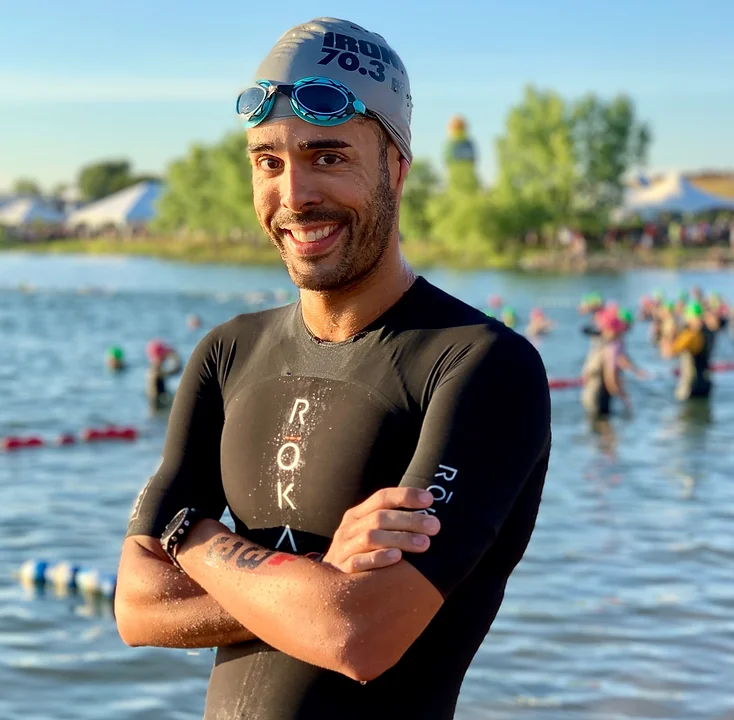 Breno MeloHead Coach · USA Triathlon, Road Runners Club of America, TrainingPeaks
Email me my heat pace chart
Your adjusted paces across the temperature range, on one printable card for the summer block.
No spam. Unsubscribe anytime. We never sell your email.
Temperature-driven marathon pace decrement
Adjusted pace = goal pace × (1 + d), where d rises with wet-bulb globe temperature.
Marathon field data show a roughly 0.3–0.4% slowdown per °C above about 10–12 °C WBGT,
steepening above 20 °C.
- You are not heat-acclimated. Ten to fourteen days of acclimation recovers a large share of the loss.
- The effort is longer than about 30 minutes, where thermal load accumulates.
- The decrement was derived from marathon field data; shorter events are affected much less.
- Faster runners lose proportionally less pace than mid-pack runners at the same temperature.
- Sun exposure, wind and radiant load are not captured by air temperature alone.
Finish-time data from tens of thousands of runners across seven large marathons (Ely et al.) and Vihma's multi-year marathon weather analysis. Cohorts are recreational-to-elite road runners.
Formula, constants and cited sources last verified on . Spotted something wrong? Email breno@brenoamelo.com and it gets corrected and dated.
How the heat adjustment is calculated
Above roughly 55°F, more of your cardiac output goes to the skin instead of working muscle, so the same pace costs more oxygen and more heart rate.
Humidity matters because evaporation is your only real cooling route. Heat index combines both into one effective temperature before the pace penalty is applied.
Acclimated athletes lose roughly a third less pace, which is why a 10-14 day heat block before a hot race is worth more than any gadget.
References
Every physiological claim on this page traces to one of the primary sources below — the original paper, textbook or governing-body standard, not a secondary write-up.
- 01Ely MR, Cheuvront SN, Roberts WO, Montain SJ (2007). Impact of weather on marathon-running performance. Medicine & Science in Sports & Exercise 39(3):487–493. doi:10.1249/mss.0b013e31802d3aba
- 02Vihma T (2010). Effects of weather on the performance of marathon runners. International Journal of Biometeorology 54(3):297–306. doi:10.1007/s00484-009-0280-x
- 03Périard JD, Racinais S, Sawka MN (2015). Adaptations and mechanisms of human heat acclimation: applications for competitive athletes and sports. Scandinavian Journal of Medicine & Science in Sports 25(S1):20–38. doi:10.1111/sms.12408
Free to use on your own site
Running club, race site, coaching blog — paste this snippet and your readers get the heat pace adjuster without leaving your page. It resizes itself to fit and keeps a credit link back here. No sign-up, no tracking script, no cost.
<iframe
  id="bm-embed-heat-pace"
  src="https://www.brenoamelo.com/embed/heat-pace"
  title="Heat Pace Adjuster by Breno Melo Endurance Coaching"
  width="100%"
  height="560"
  loading="lazy"
  style="border:0;width:100%;max-width:680px"
></iframe>
<script>
  window.addEventListener("message", function (e) {
    if (e.origin !== "https://www.brenoamelo.com") return;
    if (!e.data || e.data.type !== "bm-embed-height" || e.data.slug !== "heat-pace") return;
    var f = document.getElementById("bm-embed-heat-pace");
    if (f) f.height = e.data.height;
  });
</script>Using this page in your own work?
Copy a formatted reference below. If you are quoting a number from this page, please link back to it so readers can check the source and the date it was last reviewed.
Breno Melo, "Heat & Humidity Pace Calculator — Breno Melo Endurance Coaching", Breno Melo Endurance Coaching (last reviewed 14 June 2026). https://www.brenoamelo.com/calculators/heat-pace
The Heat Acclimation Protocol
Ten to fourteen sessions that buy back the pace heat takes away.
Heat & Humidity Pace Chart
How much to slow down at every temperature and dew point.
Zone 2: Why Slow Training Builds Fast Athletes
Easy pace is the engine room of every PR — here is how to use it.
Marathon Fueling Strategy
Carbs per hour, gel timing and the gut training that makes it work.
Train for the conditions, not around them
What to wear and how to pace when the forecast is against you.
Heat changes today's pace. Apex changes the plan.
Adjusting one run is easy. Adjusting a build through a hot summer is not. Apex re-plans the week when conditions and fatigue say your original session is a bad idea.
- A full training week generated from the numbers on this page
- Sessions that re-plan themselves when you miss one or feel wrecked
- Check-ins, streaks and a coach you can message inside the app
$9.99/month or $79.99/year. 14-day free trial. No card needed to start. Cancel in one click.
Train smart in the heat. Coach the rest.
Pace adjustment is step one. 1:1 coaching builds heat tolerance the right way — without breaking your block.
Boston-based · Trilingual EN/PT/ES · RRCA · USAT · TrainingPeaks L2 · 12× Boston qualifier